EMT Practice Test

1. Question Content...


Question List

Question1: A driving relationship is _____________________.

Question2: Which of the following is NOT required when performing weekly or monthly schedule updates?

Question3: Each of the following accurately describes total float in a schedule EXCEPT:

Question4: When using a detailed estimate as the basis for work package/activity durations, which element does NOT need to be identified before the activity durations can be calculated?

Question5: Which activity is drawn in the incorrect position?

Question6: Determine the driving activity for Activity 10001.

Question7: What problems can a soils engineer deal with on a project?

Question8: Determine the correct formula and date for the late start for Activity 9001.

Question9: Which of the following types of delay will NOT result in a time extension and additional compensation for a contractor?

Question10: Of the following update procedures, which is the least important in achieving an accurate forecast for completion of a construction schedule?

Question11: What is the cycle time?

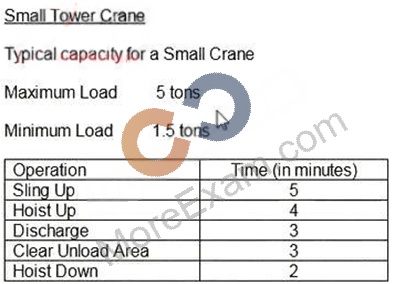
Question12: Assuming that you had only one crane capable of 30 lifts per day, 3 column pours requiring 28 lifts each, plus associated assorted work requiring an additional 150 lifts, what is the minimum planned working duration for this work?

Question13: What is the free float for Activity F?

Question14: During proofing of the product manual, a problem was discovered requiring 15 days additional time to affect a correction. How can the date of availability be maintained?

Question15: Activity C is a

Question16: If drafting of the product manual overruns its planned duration by 5 days, how many days may the manufacturing be delayed without affecting release of the product?

Question17: Time-scaled logic diagrams are

Question18: In the "normal" schedule, excluding Activity 1000, what activity(s) are concurrent with Activity 3001?

Question19: What is a key first step in developing a critical path method schedule?

Question20: If a new hammock activity covering activities 6001 through 6003 is developed, what are governing predecessor and successor activities?

Question21: In order for a claimant to be entitled to an extension of contract time for a delay event (and further to be considered compensable):

Question22: In a graphical earned value analysis, what time-scaled value determines the reporting intervals for both schedule and cost performance?

Question23: In its simplest form, what is the main drawback of critical path method scheduling?

Question24: These are the activities on the critical path:

Question25: If the administrative constraints for developing the precedence diagram, as provided in the contract documents, indicate that no individual construction activities shall have a longer duration of two months, how many activities in the "normal" schedule would be affected?

Question26: How many work days does it take to move the product from testing to sale?
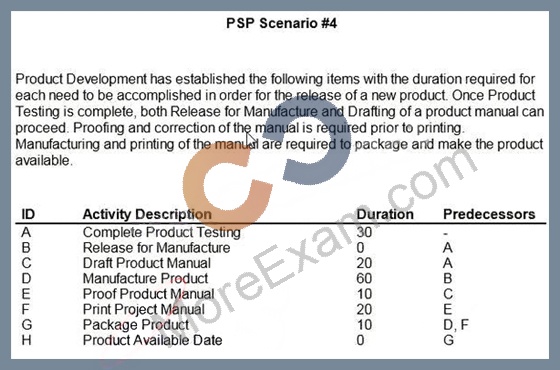
Question27: How many workdays occur from the start of the Product Testing to the Product Available milestone?

Question28: Why does activity 11001 not show successor activities?

Question29: Scenario:
The entire network consists of the following activities and relationships. Activity A is twenty days long and is tied to Activity B, a ten-day activity, with a finish-to-finish tie with a lag value of five Activity B is tied to Activity C, a twenty-day activity, with a start-to-start relationship with a lag value of five.

PSP Activities Table
Scope Known about Rock-Filled Dam Project:
The dam requires river diversion and work over two or more rainy seasons. The contract is lump sum, competitively bid, and will be self-performed. The owner has attempted to shift all risk to the contractor by employing "no differing sit conditions" and "no damage for delay" clauses. There is a bonus/penalty provision of $2,500 per calendar day for early or late delivery. The early completion bonus is capped at $500,000, with no cap for late delivery penalty.
Liquidated damages end at the finish of demobilization. Indirect costs per calendar day are $2,800 for the
"normal" schedule and $3,200 for the "crashed" schedule. The winter/wet weather season is 151 days between October 15 and March 25 of each year, reduces the efficiency of the contractor's operations by 20% and costs the contractor $10,000 per day. Assume a start date of March 5, 2001 and use a 7-day work week.
The following table lists work activities as planned by the contractor.

Theoretically construct a summary activity for only those activities with a finish-to-start relationship for Activities 8001 through 10001. Using the "normal" schedule, what is the cost of this hammock?

Question30: When reconstructing a CPM schedule electronically from a hardcopy, which of the following is NOT required to determine the critical path?

Question31: What method would be the best way to determine the most likely as-built critical path of a project that is underway, and the schedule of which has been partially progressed?

Question32: What is the result of a forward pass calculation?

Question33: Activity durations are normally estimated in an intuitive and subjective way. All of the following will improve duration accuracy EXCEPT

Question34: Using the normal schedule and excluding general conditions, which activities are NOT on the critical path?

Question35: Determine the correct formula and date for the late finish for Activity 2001.

Question36: Using a 1.75 cubic yard [1.34 cubic meter] bucket, how many lifts does it take to pour each 2.000-cubic foot
[56.64 cubic meter] column?

Question37: Which of the following is NOT required when initially planning a project?

Question38: Which statement is true?

Question39: Assumptions made during the planning stage should be_____________.

Question40: Each column must be poured in one day. Each column requires 2,000 cubic feet of concrete. The lift bucket has a capacity of 40 cubic feet. How many lifts will be required per column pour?

Question41: What day would Activity C complete if the duration of Activity B was reduced to zero?

Question42: The characteristic of the precedence diagramming method that models construction projects differently than the arrow diagramming method is that it____________.

Question43: Determine the correct formula and date for the late finish for Activity 2002.

Question44: Resource planning must take all of the following into account except for:

Question45: In the normal schedule, excluding Activity 1000. what activity(s) are concurrent with Activity 3001?

Question46: Which is NOT an industry-recognized methodology for quantifying critical delay?

Question47: Which of the following are NOT normally included in the project scope statement, either directly or by reference?

Question48: Which of the following will NOT affect the total float calculation of a non-resource leveled schedule?

Question49: Is activity 7001 pictured correctly in the precedence diagram?

Question50: Which of these letters, symbols or words best approximates the graphical shape of a project's cumulative BCWS?

Question51: Identify the minimum project duration.

Question52: What method offers the best chance of the schedule being used effectively to implement the project in the field?

Question53: Determine the correct formula and date for the late finish for Activity 2002.

Question54: If a detailed estimate is NOT available to assist in the formulation of activity durations but unit quantities have been identified, what information can be utilized to estimate work package/activity durations?

Question55: Considering the information provided for the project, what is the factor that most influences the successful crashing of the schedule?

Question56: Who will receive the most benefit from a master schedule of the Spring Highway project?

Question57: Using the "normal" schedule, given Activity 3001 and the relationship with Activity 4001, what is indicated?

Question58: In analyzing a logical chain of activities in a critical path method (CPM) schedule, what do differing total float values within that chain typically indicate?

Question59: The activity with the most total float is:

Question60: In a "crashed" schedule, which is a chain of activities that precede activity 2004?

Question61: If Activity E's duration changes to 4 months, what is the overall duration of the project.

Question62: What does the heavy, vertical line at "X" represent?
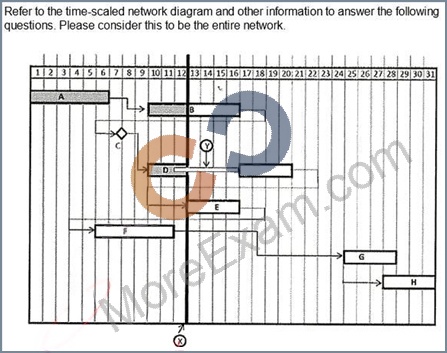
Question63: Identify the late finish to develop plans and specs.

Question64: Under which circumstance should one perform resource-leveling calculations?

Question65: For which of these delays should an owner grant a time extension?

Question66: What is the workweek period for this project?

Question67: Assuming activities 2001 through 2004 comprise the same WBS element, construct a WBS summary activity for activities 2001 through 2004. Use the normal schedule, what is the cost of the activity?

Question68: What is accurate about Activity 7001 in the precedence diagram?

Question69: Prior to the beginning work on Activity 6001, the scope is changed by executed change order to increase the activity duration by thirty days and rock fill by 100.000 cubic meters If the project has progressed as scheduled up to the point of the executed change order, what activities would be changed on the next project update?

Question70: Assuming a total of 30 lifts per crane per day, what is the maximum number of lifts that could be accomplished using 3 small tower cranes over a 5-day period?

Question71: The congested site only has room for 3 cranes to operate concurrently. Only 1.75 cubic yard ICY] or1.34 cubic meter [CM] concrete buckets are available. Each crane can perform up to 35 lifts per day. Assuming a total of 30 lifts per crane pet day. what is the maximum volume of concrete that could be placed using 3 small tower cranes over a 5-day period?

Question72: If no time extensions are granted and all actual delays are as described above, what will the total float calculation be at the end of the project?

Question73: Using the "crashed" schedule, if you start Activity 2002 on August 12, 2001, what is the finish date for Activity 2002?

Question74: If after calculating a schedule an activity exhibits negative total float, which of the following is certain? The activity

Question75: Theoretically construct a summary activity for activities 2001 through 2004. Using the "normal" schedule, what is the cost of the hammock?

Question76: Which of the following documents is most likely to be of the LEAST value to a planner/scheduler when planning a contractor's baseline critical path schedule for the construction of a large high-clearance bridge located very near an airport? The contractor has been awarded the contract.

Question77: SUBCO is a potential concrete bridge contractor based in a metropolitan area 300 miles away from your project. They have offered to supply manpower and equipment t BILCO at a per diem rate of $3,000 above their direct labor and equipment rates. In doing a cost benefit analysis, which of the following is NOT a consideration?

Question78: What is the remaining work duration of Active D?